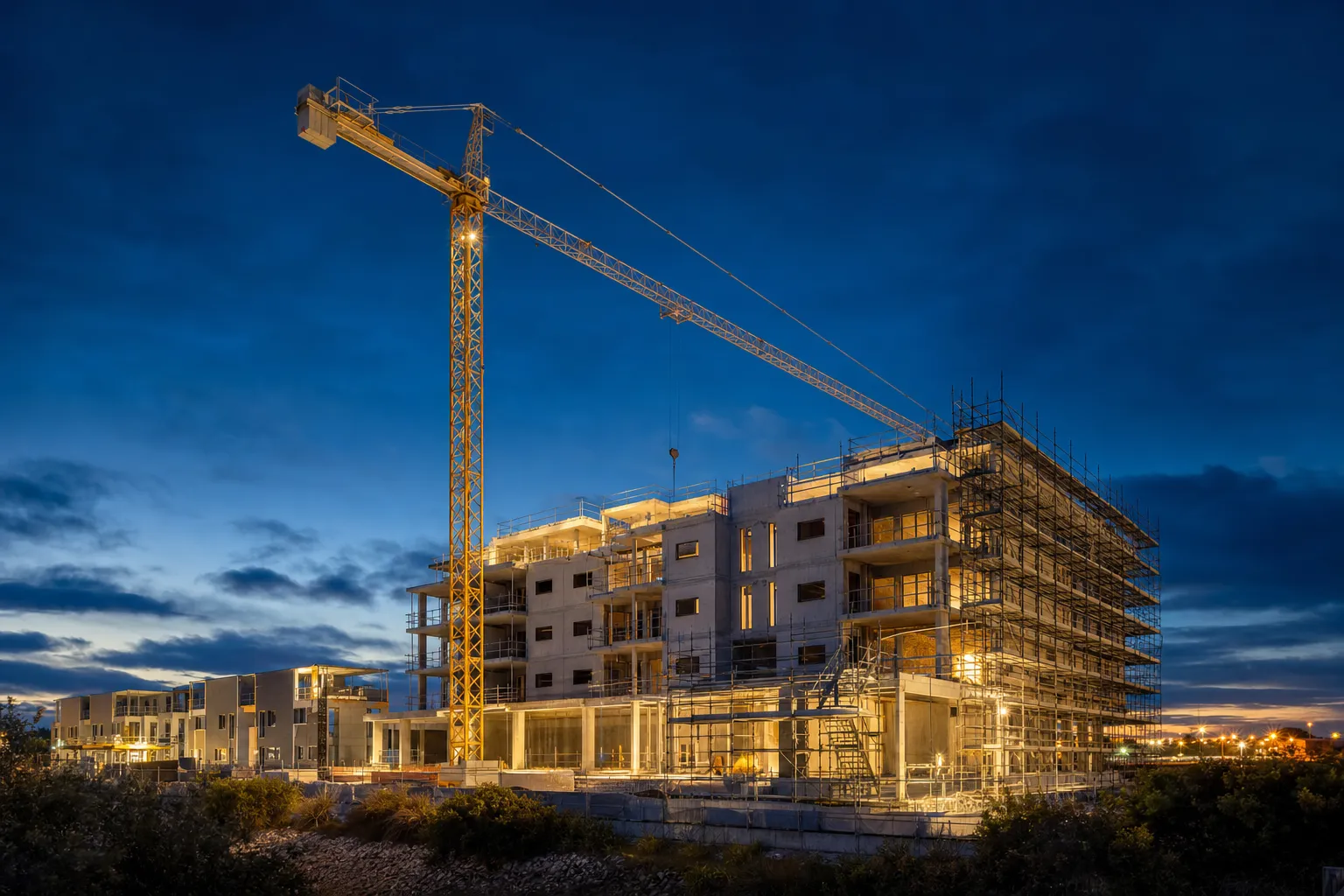
Property development finance, placed across a panel of lenders
Funding for projects where you add value through a build, with senior, stretched senior and mezzanine financing arranged across a whole-of-market panel of lenders.
Property development finance funds the land and the build where you add value through works. The financing is sized against Gross Realisation Value (GRV), the worth of the finished scheme, and against your total development cost, then released in stages as the development project moves through certified progress. You draw and pay interest on each stage rather than carrying the full amount from day one. The right capital stack can be the difference between an investment that funds and one that stalls.
Windsor Finance is a broker, not a lender. We hold no own capital and approve nothing. We take your development project to a panel of Australian bank and private lenders, and place the financing where the appetite and pricing fit. Most property development financing is business-purpose finance, generally outside the National Consumer Credit Protection Act 2009 on a signed business-purpose declaration, and every fee is disclosed in writing before you commit.
Key facts
- Indicative cost ~7 to 11% p.a. on senior facilities for established developers; line and establishment fees on top
- Up to around 65% of GRV, or up to 80% of total development cost, whichever binds first
- Indicative terms in 3 to 7 business days; first drawdown typically 4 to 10 weeks from instruction
| Scenario | Indicative rate | LVR |
|---|---|---|
| Senior (experienced) | ~7-11% p.a.* | ~65% GRV |
| Stretched senior | By case* | ~80% TDC |
| Mezzanine top-up | ~15-22% p.a.* | 80%+ TDC |
Cost calculator
How development finance works
A property development loan funds the works in stages, not in one advance. The financier sizes the financing two ways and takes whichever binds first: up to around 65% of GRV, the finished value, or up to 80% of total development cost, the acquisition plus construction costs, fees and a contingency. You contribute the balance as cash or as value already in the site. As each milestone is certified, the next stage is released and you pay interest only on what is drawn, which holds the carry cost and the developer cash flow down while the scheme is built. The facility runs the build plus a sell-down window, commonly 12 to 30 months, and repayment comes from the sale of finished stock or a refinance.
Structuring the debt and the equity
Most development financing mixes debt and equity. Senior debt is the first and cheapest layer, secured by a first mortgage over the site. Above it, a stretched facility lifts gearing in one loan, or mezzanine financing sits behind the senior lender to push total leverage toward 80%+ of cost and free your own cash for the next project. The thinner your contribution, the higher the blended cost, because the lender prices for the extra risk. Where cash is short, a preferred equity or joint-venture partner, sometimes one of the family offices or pension funds active in this space through private credit, can complete the financing stack. We structure the layers so the property development project funds on terms that match the numbers, with transparency on every cost in the agreement, not whatever one financier offers.
Development finance rates and presales
Pricing reflects the risk on an unbuilt site and current market conditions. Indicatively, a senior facility runs around 7% to 11% per annum for an established property developer with a track record; a first-time developer or a higher-risk scheme prices above that. A line fee and an establishment fee apply on top, and mezzanine financing is dearer again. Many banks want qualifying pre-sales to cover a share of the borrowing before they fund the development; private lenders offer lower-presale or no-presale financing at a higher cost. Presale expectations are confirmed on application, because lending criteria vary by lender, location and scheme. For an investor weighing the development as an investment, weigh the total finance cost over the program against the margin in your numbers, not the headline rate alone.
How to qualify and what lenders check
To secure funding, a lender underwrites the scheme and the developer together. Its due diligence covers your feasibility studies, your record on comparable residential or commercial projects, the planning approval, a fixed-price contract with a registered builder, and a credible exit through sale or refinance. The documentation it wants is the development application and consent, the costings, the build-team details, your governance and entity setup, and your assets and liabilities position. This sits alongside construction lending where the same project moves into the build. We bring the development funding expertise to package the file so the right investor or financier among the potential lenders sees a clean, complete case first time, agree the terms, and avoid the costly loop of a decline and a re-shop. That risk mitigation keeps an experienced developer, and a well-supported first-timer, fundable across the development sector.
Development finance vs a standard property loan
A development facility and an ordinary property loan, or a standard home loan, solve different problems. One funds an unbuilt scheme in stages; the other is a term loan against a finished asset.
Development finance
- Funds land plus the build, drawn in stages against the works
- Sized against GRV and total development cost, whichever binds
- Interest charged only on the staged amount drawn so far
- Repaid from the sale of finished stock or a refinance
- Underwritten on the numbers, the build team and the exit
Standard property loan
- Funds a completed property, advanced in full at settlement
- Sized against the value of the existing security
- Interest charged on the whole balance from day one
- Repaid over the full term from rent or other income
- Underwritten mainly on serviceability
Where development finance fits
A project with planning approval and numbers that stack up.
Private lenders where a standard presale hurdle does not fit the scheme.
Mezzanine financing or a stretched senior facility to free cash for the next project.
The questions developers ask first
How much do I need to put in? +
Can a first-time developer get funded? +
One financier declined my scheme. Is that the end? +
Common questions
What is GRV? +
How are funds released? +
Is this regulated under the NCCP Act? +
Do you arrange government funding? +
Explore the development finance hub
Construction finance
Stage drawdowns against a fixed-price contract once the scheme moves into the build.
Read more →Bridging loans
Short-term money to secure the site ahead of the facility, or hold finished stock.
Read more →Commercial property loans
Take a completed commercial scheme onto a longer-term investment facility.
Read more →Read the guides
Plain-English guides that sit under this hub. The wider finance guides hub links to every guide we publish.
Get indicative development terms in 3 to 7 days
Tell us the scheme, the numbers and your exit. A broker comes back with indicative structures from suitable lenders, with the fees set out in writing. Structuring and shortlisting cost nothing until you give the go-ahead.