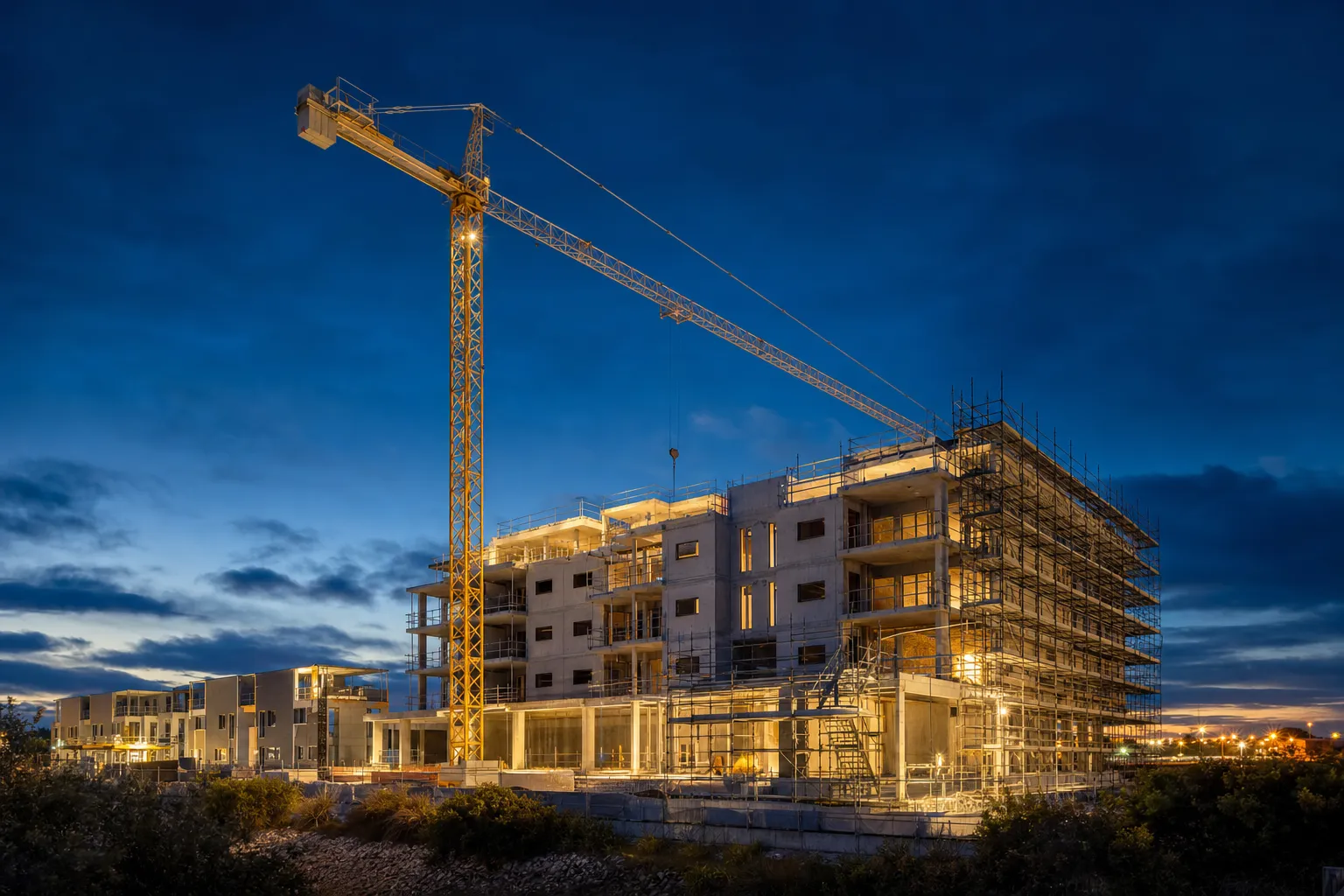
Construction loans: a building loan drawn in stages
A construction loan funds the build itself, drawn down at base, frame, lock-up, fixing and completion against a fixed-price building contract and quantity surveyor sign-off.
A construction loan funds a build as the work is done, rather than handing over the whole loan amount upfront. The money is released in stages against fixed stages of construction, so you are charged interest only on what has been drawn so far. That keeps holding costs down while the home is being built and matches the finance to the work on the ground.
Windsor Finance is a broker, not a lender. We hold no own capital and approve nothing. We place build finance across a panel of bank and non-bank financiers, and match the structure to your trade, your contract and your exit. Most construction lending we arrange is business-purpose finance for developers and investors, generally outside the National Consumer Credit Protection Act 2009, on a signed business-purpose declaration. A licensed builder, a fixed-price contract, warranty insurance and sensible cost contingencies keep these deals moving, and every fee is disclosed in writing before you commit. This hub covers the stages, progress payments, the interest rate, what lenders check, and how to apply.
Key facts
- Indicative cost ~6.5% to 10% p.a. on senior construction debt, depending on lender type, the trade and LVR
- Up to around 80% of total development cost, or up to 65% of on-completion value, whichever binds first
- A weak builder or open-ended contract is the most common reason construction finance stalls
| Scenario | Indicative rate | LVR |
|---|---|---|
| Senior construction (bank) | ~6.5-9% p.a.* | ~80% TDC |
| Non-bank construction | ~8-10% p.a.* | ~65% on completion |
| Owner-builder | By case* | By case |
Cost calculator
How construction loans work
A construction loan, sometimes called a construction home loan, is a type of home loan designed for building a new home, a knock-down-rebuild, or to build or renovate, rather than buying a finished dwelling. Instead of advancing the full amount at the start, the financier releases money in stages as the build progresses, so you pay interest on the amount drawn. That is the single biggest reason this facility is cheaper to carry than a same-sized term loan while the home is being built. The land is funded first where it is part of the deal, then the building portion follows as construction progresses. Most lenders run interest only loans during the build, so you make interest only payments on the rising loan balance and keep your repayments low, then revert to principal and interest once construction is complete and the work has been done.
Progress payments and how the build is funded
The facility is funded through a progress payment schedule tied to fixed drawdowns: deposit or slab, frame, lock-up, fixing, and completion. Each progress payment is paid directly to your builder once a quantity surveyor or valuer confirms the work has been completed. The first progress payment funds the slab; the final progress payment is made once the home is finished and signed off. You are charged interest only on the portion of the loan drawn so far, so early in the build the cost is small and rises as each stage of the construction process is reached. Because payments to your builder follow completed work rather than an invoice submitted in advance, an open-ended contract or front-loaded claims is the fastest way to stall a drawdown, which is why we line up a workable plan before the build starts.
Construction loan interest rates and what lenders check
Pricing sits close to a standard variable home loan, and a variable rate home loan is a useful comparison; indicatively, the interest rate on senior construction debt runs around 6.5% to 10% per annum depending on the financier, the build and the LVR. The interest rate, the comparison rate and the terms and conditions are confirmed on application once the lender sees your financial situation. During the construction period most lenders charge interest only, so the repayment stays low, then the facility reverts to principal and interest over the remaining period of your loan once the home is built, unless an interest only term is arranged for investment properties. Fees and charges apply on top: an establishment fee, valuation and inspection fees, and legal costs, all set out in writing.
Before they lend, financiers underwrite the trade and the contract as hard as they underwrite you: a registered, licensed builder, a fixed-price contract with a clear schedule, the builder’s warranty insurance, and a contingency for cost overruns. Your loan application covers the deposit or land equity, income evidence, an assets and liabilities position, and the plans and permits. For business-purpose construction by developers and investors, the deal is assessed on the construction project and the exit, not consumer serviceability rules. Indicatively you can borrow up to around 80% of total development cost, or up to 65% of on-completion value, whichever binds first.
Construction loan vs a standard home loan
A build facility and an ordinary home loan solve different problems. One funds a build in stages and charges interest only on the amount drawn; the other is a home loan that advances the full amount upfront to buy a finished property.
Construction loan
- Released in stages as the build progresses
- Interest charged only on the amount drawn so far
- Interest only during construction
- Paid to the trade against completed, certified work
- Switches to normal repayments once the home is finished
- Underwritten on the trade, the contract and the exit
Standard home loan
- Full balance advanced upfront at settlement
- Interest charged on the full balance from day one
- Repaid over the full term from the start
- Paid to the seller to buy a finished property
- No staged drawdowns or progress inspections
- Underwritten mainly on income and serviceability
Where a construction loan fits
Replace an existing dwelling with a single new build, or a heavy renovation, under a fixed-price contract.
A licensed builder, staged drawdowns, and a clear exit to sale or refinance.
Land plus construction funded at each stage of construction with progress payments to the trade.
The things developers ask first
Do I pay interest on the whole amount from day one? +
The bank declined my build finance. Is that the end? +
Common questions
What deposit do I need to build? +
How are repayments structured during the build? +
Can I act as an owner-builder? +
How do I apply for a construction loan? +
Explore the construction finance hub
Development finance
Land plus construction on multi-unit schemes, with senior, stretched and mezzanine structures.
Read more →Bridging finance
Short-term money to settle the site or hold a finished build until sale or refinance.
Read more →Investment property loans
Take a completed build to a long-term investment loan.
Read more →Read the guides
Plain-English guides that sit under this hub. The wider finance guides hub links to every guide we publish.
Get indicative construction terms quickly
Tell us the site, the trade, the contract and the loan size. A broker comes back with indicative structures from suitable lenders, with the fees and charges set out in writing.