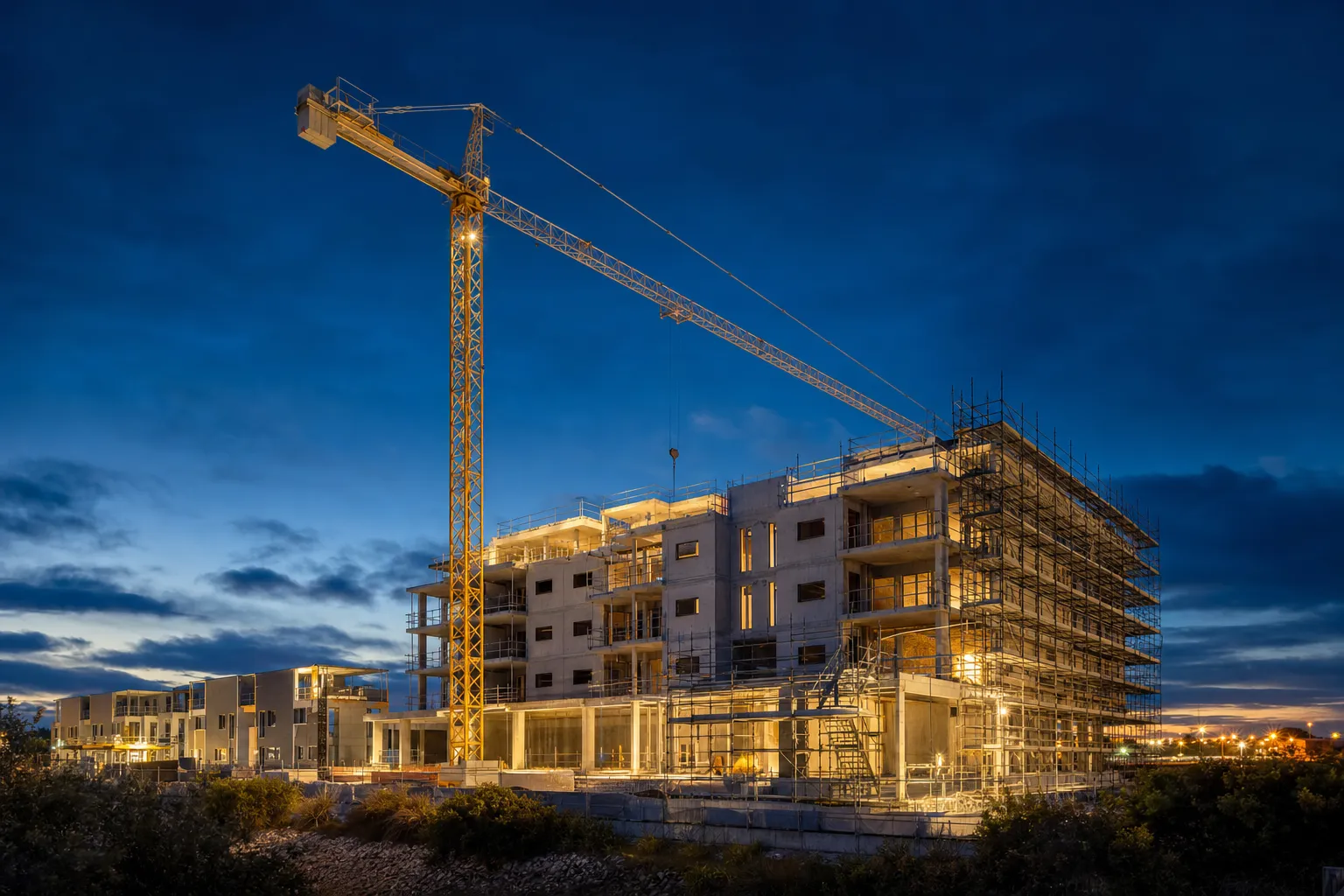
Construction loan lenders compared: CommBank and the wider market
Compare CommBank and other Australian construction lenders on LVR, drawdowns, builder rules and speed. A broker checks bank and non-bank lenders in one pass. Indicative terms in 24 to 48 hours.
A CommBank construction loan is one option among many. Commonwealth Bank, like most major Australian banks, funds a build through progressive drawdowns released against a fixed-price building contract and a valuer’s sign-off at each stage. That structure suits a clean, prime file with a licensed builder and strong serviceability. It is not the only structure available, and it is not always the one that funds your build on time.
This guide compares how construction loan lenders differ across the Australian market: the major banks including CommBank, the second-tier and near-bank lenders, and the non-bank construction lenders. It covers what each does well, where each tends to say no, and how to read the four things that actually decide whether a build funds cleanly. It does not name confidential rates, because lenders set those on application. It does give you the framework to compare.
Windsor Finance is a finance broker, not a lender. We take your build to a panel of bank and non-bank lenders, then package and place it with the one that fits. This guide sits under our construction finance hub and the wider finance guides hub. Read the hub first if you want the full picture of how staged construction lending works.
The short answer: how the lender tiers compare. The Australian construction lending market splits into three broad tiers, and each prices and assesses differently. Major banks, CommBank among them, price keenly on clean prime files with a licensed builder and strong serviceability, but say no to lumpy or self-employed income, smaller builders, complex contracts, or unusual security, with first drawdown indicatively 4 to 8 weeks out. Second-tier and near-banks offer more policy flexibility than the majors at still-competitive pricing, drawing the line at heavily adverse credit, very high LVR, or niche security, again 4 to 8 weeks to first drawdown. Non-bank construction lenders lead on speed and flexibility around the builder and income, with lower-presale and alt-doc options, settling a clean file in 4 to 6 weeks; they do not offer the cheapest headline rate because they price for the risk. Every figure here is indicative. The lender confirms the final position on application. You only see real choice when one enquiry reaches all three tiers, which is the case for comparing through a broker rather than walking into one branch.
What a CommBank construction loan looks like in practice. Commonwealth Bank construction lending follows the standard major-bank pattern. The loan is drawn down in stages as the build progresses, not paid out in full at settlement. You typically pay interest only on the amount drawn so far during the construction period, which keeps holding costs lower in the early stages. The exact rate, the LVR ceiling, the maximum loan size, the valuation process, and the drawdown turnaround are set by the bank and confirmed on application. Where a major bank like CommBank tends to be strong: a single owner-occupier dwelling or a knock-down-rebuild, a recognised licensed builder, a clean fixed-price contract, and serviceability that reads cleanly on two years of tax returns. Where the same lender tends to struggle: self-employed or lumpy income that does not show fully on returns, a smaller or newer builder, a duplex or small unit block rather than a single dwelling, or any complexity in the contract. Step outside the box and the answer is often no. A decline at one bank also leaves a mark on your file, which makes the next application harder.
The four things that actually decide your construction loan. Headline rate is the wrong place to start a comparison. The best construction loan is the one that funds, draws down on time, and holds the timetable through to completion. Four factors decide that, and they apply to every lender in every tier. The lender’s view of your builder: Australian construction lenders look hard at the builder’s licence, the fixed-price building contract, builder’s warranty insurance, and the cost contingencies, and a weak builder or an open-ended contract is the single most common reason construction finance stalls. Where your borrowing limit lands: senior construction debt typically runs up to around 80% of total development cost, or up to 65% of on-completion value, whichever binds first, indicative ranges the lender confirms on application. How drawdowns are released: funds release in stages against progress claims (base, frame, lock-up, fixing, completion), each signed off by a quantity surveyor or valuer before the next tranche, so a lender that turns drawdowns around quickly keeps your builder paid and your program moving. The price for the risk: indicative senior construction rates run roughly 6.5% to 10% per annum, set by lender type, the builder, and your LVR, with line and establishment fees on top. The cleaner the file and the lower the LVR, the cheaper the money. These are honest ballparks, not promises.
Bank versus non-bank construction lenders. Bank construction lenders, CommBank among them, price keenly on clean prime files. They suit owner-builders with a licensed builder, a single dwelling, and strong serviceability. They move more slowly and apply tighter policy, with firmer presale and serviceability requirements and lower tolerance for an unusual builder or a complex contract. Non-bank construction lenders sit at the other end: they assess the security and the exit more than the credit file, turn around faster, take smaller and newer builders, accept alt-doc income evidence such as BAS statements and accountant letters, and offer lower-presale or no-presale options on the right deal. You pay for that flexibility in the rate, and for a build a major bank cannot fund in time or will not fund at all, a non-bank lender is often the difference between starting on schedule and losing the slot. Second-tier and near-bank lenders sit in between, with more policy room than a major bank and pricing closer to one than a non-bank charges. None of this makes one tier right and another wrong. A clean prime owner-occupier dwelling may genuinely be cheapest at a major bank; a duplex on a knock-down-rebuild with self-employed income may only fund cleanly through a non-bank lender, and the slightly higher rate over a 12-month build is a fraction of the cost of a stalled program.
The timing gap that catches owners out. You often have to pay your builder before the lender releases the next draw. A builder finishes the frame and invoices. The lender will not release frame-stage funds until its valuer inspects and signs off, which can take days. Meanwhile the builder wants paying to start the next stage. That mismatch is the most common cash-flow squeeze on a build. It is the reason a lender’s draw process matters more than its headline rate, and it is exactly the kind of difference a like-for-like rate table hides. When you compare lenders, ask how each one handles inspection timing, draw release, and progress-claim turnaround. A lender whose draw process keeps pace with your builder’s program protects your timetable; one that lags creates a gap you have to fund yourself.
How the regulation affects which lender you compare. Most construction finance is business-purpose or investment lending. Lending wholly or predominantly for business or investment purposes, other than residential property investment by an individual, is generally not regulated under the National Consumer Credit Protection Act 2009, and a signed business-purpose declaration is the standard evidence. Some residential investment lending to individuals can be NCCP-regulated, in which case responsible lending obligations apply and the lender or broker arranging it must hold an Australian Credit Licence or act as a credit representative under one. This distinction affects the documentation and verification each lender requires, and it narrows the lender pool, so it is worth knowing which category your build falls into before you compare. A broker will confirm which applies to your situation. The purpose of each deal is confirmed in writing before it proceeds.
Why compare through a broker rather than lender by lender. You can apply to CommBank, get a decision, and if it is no, apply to the next bank and start again. Each application takes time, each one can leave a mark, and you are comparing one product at a time with no clear view of the rest of the market. A broker checks every major bank plus second-tier and non-bank construction lenders in one pass, so you see the structures that fit your build side by side, not the one your bank happens to sell. Panel breadth across bank and non-bank. One enquiry reaches major banks, near-banks, and non-bank construction lenders with different LVR, builder, and draw appetites. No own capital, no bias. Windsor holds no balance sheet, so the recommendation follows your build, not a lender quota. Right lender first time. A clean, packaged file placed with the correct lender avoids the costly cycle of decline, re-shop, and a damaged credit record. Specialist, not generalist. We work on property and construction finance daily, and the builds banks find awkward are the ones we place most often.
Where to go next. If you want the full mechanics of staged construction lending, the construction finance hub covers how the product works end to end. For a broader view of property finance options, the finance guides hub links to bridging, development, and commercial lending guides. When you are ready to compare real structures for your build, the fastest route is to speak to a broker.
Key facts
- A CommBank construction loan is one option among many. Majors, second-tier/near-banks, and non-bank construction lenders each price and assess differently
- Indicative senior construction rates ~6.5–10% p.a.; LVR up to ~80% of total development cost or ~65% of on-completion value, whichever binds first; lender confirms on application
- Four things decide a build: the lender’s view of your builder, your borrowing limit, how drawdowns release (base, frame, lock-up, fixing, completion), and the price for the risk
| Scenario | Indicative rate | LVR |
|---|---|---|
| Major banks (incl. CommBank) | Indicative* | ~80% TDC |
| Second-tier / near-banks | Indicative* | By case |
| Non-bank construction | ~6.5–10% p.a.* | ~65% on-completion |
Cost calculator
When this fits
A single dwelling or knock-down-rebuild, a licensed builder, a clean fixed-price contract, and serviceability that reads cleanly on two years of returns: a major bank like CommBank often prices keenly here.
Lumpy income that does not show fully on returns, a newer or smaller builder, a duplex or small unit block, or contract complexity: a non-bank construction lender assesses the security and exit and often funds where a major says no.
When the draw process and progress-claim turnaround decide whether your builder keeps moving, the right lender is the one whose draw release keeps pace with the program, not the lowest headline rate.
Common questions
Does CommBank do construction loans? +
Is a bank or a non-bank construction loan better? +
What LVR can I get on a construction loan in Australia? +
How do construction loan progress payments work? +
Does Windsor Finance lend the money? +
Is construction finance regulated? +
Indicative terms in 24 to 48 hours
Tell us the property, the loan size and your exit. A broker comes back with indicative structures inside 24 to 48 hours.